Sunday, September 19, 2010

Talk: L.M. Montgomery's Legal Battles with Her Publisher

I'll be giving a talk on Friday afternoon at Osgoode Hall Law School, York University, in Toronto on L.M. Montgomery's legal battles with her first U.S. publisher, L.C. Page and Company. The event is the first Feminist Friday of the year, part of a series hosted by Osgoode's Institute for Feminist Legal Studies. It's open to the public, and I expect it will be good fun, so please come if you're in Toronto and you're interested in hearing me and my colleague Shelley Kierstead speak. Also, I understand that Osgoode's new dean, Lorne Sossin, has graciously agreed to serve as commentator. You can find all the details on the poster below:


And if you need help finding Osgoode Hall Law School on the York University campus, maps are available here.

Sunday, July 25, 2010

Jane Austen's Fight Club


Jane Austen's Fight Club: "No corsets, no hatpins, and no crying."

(via Jezebel)

Wednesday, July 07, 2010

An Interview with Kathleen Winter About Her New Novel Annabel


Annabel is the story of an intersex baby, born in a Labrador village in 1968. Mother Jacinta and her friend Thomasina, also present at the birth, initially avoid assigning the baby a pronoun, wanting to keep all possibilities open. But father Treadway decides that the baby will be raised as a boy, Wayne. Medical intervention and relentless socialization by Treadway in the very masculine hunting culture of Labrador render Wayne visibly male. But Jacinta and Thomasina quietly nurture Wayne's hidden female self, Thomasina even bestowing on Wayne the name of the daughter she has recently lost, Annabel. The novel spans twenty years, tracing Wayne's sometimes harrowing voyage of self-discovery, and also those of Jacinta, Thomasina, and Treadway as they come to terms with Wayne's identity and their own.

Annabel is a very powerful and thought-provoking novel. I have not stopped pondering it since I finished reading, so I was very pleased when author Kathleen Winter agreed to answer some of my questions. My interview with her is posted below.


KS: One of the epigraphs with which the novel opens is from Virginia Woolf's Orlando. That’s one of my favourite books, and I think I would have thought of it as I read even without the epigraph given that you explore some of the same questions about gender identity across time and space in Annabel. Can you tell me about some of the influences or inspirations, literary or otherwise, behind Annabel?

KW: I have had a lot of literary inspiration: Heinrich Boll, for his tenderness and humanity in books like The Bread of those Early Years; Virginia Woolf for her novels but also her diaries; E.M. Forster for his explorations of the barricades of class and gender; Roald Dahl for his explosive insistence on dark truth with one hairline fracture of golden light; Katherine Mansfield for her attention to detail and, again, her tenderness – I'm thinking here of "I seen the little lamp" in Mansfield's The Doll's House.

KS: Annabel is deeply rooted in the Labrador landscape. There's a lovely line near the beginning about the relationship of people to land there: "No one minded being an extra in the land's story." What drew you to this landscape in your writing?

KW: In Annabel I depicted the Labrador landscape as a magnetic force that gives off its own energy and seems to have visible light emanating from the ground. This is what I saw when I was there. I also saw people who are expansive in their thinking, and I think the big land and sky and rock and water are inside the people in a way that doesn't happen everywhere. And the land is generous. If you go there you can partake of this breathing between flesh, spirit and ground, if you are open to it. I felt this when I was there, and I tried to put it in the book.

KS: That rootedness notwithstanding, there's a lot of travel in Annabel, with characters moving between Labrador, St. John's, Boston and Europe. Travel often represents reinvention in literature, but nearly all of the characters in Annabel seem to become more themselves away from home. Every journey is somehow an inward one. Can you reflect a bit on the connection drawn here between travel and self-knowledge?

KW: I hadn't thought of this consciously but I guess Wayne, Thomasina and Treadway do become more themselves away from home. It isn't that they don't change – they shift their inner cogs considerably – but you are right, those shifts are shifts toward greater self-expression, not towards something unlikely or discontinuous with their earlier selves. I have traveled a lot so maybe this is a facet of travel that has entered the writing unbeknownst to myself. Maybe I'd have to go on a trip and read the book to see it!

KS: There's a reference early in Wayne's childhood to his knowledge of his authentic self as contrasted with the child that his father requires him to be. (Of course, this is sorely tested later.) Do you think all children begin with a sense of authentic self, or is Wayne unique in this, developing it in response to the unusually intense pressure he's under to assume a rigid, ill-fitting identity?

KW: I think each child is fiercely authentic from the beginning and that it is up to the people around that child to find out who has come into the world by listening as well as through insightful teaching. Of course this doesn't always happen, and we suppress whole generations of children through ineffective methods of socialization. But the authentic self in each person is very strong, and sometimes it survives and even flourishes, and that individual becomes a blessing to others.

KS: Later, Wayne seeks not authenticity but wholeness. Is that another word for the same thing, or is it something different?

KW: For me authenticity happens within the individual and includes things like the development of talents and the ability to speak one's truth anywhere. Wholeness would include authenticity but would also encompass the health of the physical and the emotional body; the ability to feel and receive love, and to have a sense of belonging.

KS: Annabel is your first novel, but your previously published work includes a novella, short stories, and creative non-fiction. How does your writing process change (or does it) as you move across genres?

KW: I think my writing process changes as I gain more life experience, and maybe that is part of how I have moved through shorter to longer genres. It has taken me many years to be able to write a novel that shows the points of view of people of different ages and personalities. I like that Madeleine L'Engle has said the great thing about getting older is that you don't lose all the other ages you've been. But I remain thrilled about the radical possibilities of short stories.


Thanks to Kathleen for her generous and illuminating responses to my questions!

I highly recommend Annabel. You can learn more about it and about Kathleen Winter at the Anansi website here.

Saturday, July 03, 2010

Rereading Anne of Ingleside


After this latest reread, Anne of Ingleside remains my least favourite Anne book, and my least favourite but one L.M. Montgomery novel. Anne's children are noxiously cute and her perfect motherhood cloying. But I'm glad to have dipped back into it all the same for the dark undercurrent in it that intrigues me. I remembered the story of Peter Kirk's funeral, and of Anne and Gilbert's anniversary reunion with Christine Stuart as strong points of the book. But I don't think that I'd noticed before that most of the rest of the episodes in it, even the cutesy kid ones, are also tales of disillusionment. I'm looking forward to reading The Blythes are Quoted with this fresh in my mind and thinking about these books together as examplars of what editor Benjamin Lefebvre terms Montgomery's "late style." Also, speaking of style, this time around I appreciated how well structured Anne of Ingleside is, weaving deftly through seasons and years and in and out of key moments in different characters' lives, and thereby painting a rich picture of the Blythe household and the broader Glen St. Mary community. Finally, the meeting of Susan Baker and Rebecca Dew, two of my favourite characters in Montgomery's oeuvre and indeed in literature generally, is in itself worth the price of admission. What fun Montgomery must have had writing that bit of dialogue and the correspondence that followed. On now to a reread of Rainbow Valley.

Sunday, April 04, 2010

National Divisions Hide More than They Reveal

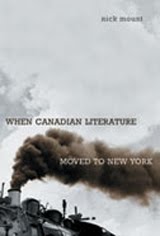
Another passage from Nick Mount's When Canadian Literature Moved to New York that I can't resist sharing:

But however legitimate a concern for cultural nationalists, for the literary historian, national divisions hide more than they reveal. A national focus was essential for recognizing Canadian literature's arrival, and it remains essential for periodically reaffirming its health, but it cannot explain the actual circumstances of much of that literature's production. No national model can account for [Bliss] Carman writing the first of his Vagabondia poems after reading an English law book in a New York library, or for Palmer Cox creating his Brownies by combining the Scottish legends he heard as a child in Quebec with the skills he acquired as a cartoonist in California, or for Ernest Thompson Seton submitting his career-launching story about a New Mexico wolf to a New York magazine because he was urged to do so by a Toronto economist⎯or indeed for the circumstances that produced any literary work, in any literature.

Late 19th century focus notwithstanding, this still resonates today. For a bit more on Mount's book, see my post below.

A Continental Literary Culture


An interesting snippet from one of my current reads, Nick Mount's When Canadian Literature Moved to New York, a book that traces the roots of what ultimately became a canonical Canadian literature to "the cafés, publishing offices, and boarding houses of late-nineteenth-century New York":

The problems confronting domestic literary production were real, but the domestic market was not the only option for Canadian writers of this generation: they also had access by mail or in person to the much larger American market, a market that by this time included Canada. Canadians had few home-grown literary models, but the flood of American magazines and American books into Canada provided models for them, models that had become features of a North American literary landscape. At a professional level, the decision by so many Canadian writers of these years to move to American cities wasn't about giving up one national literary culture for another; it was about moving from the margins to the centres of a continental literary culture.

My primary interest in this literary period is in L.M. Montgomery, one of the few Canadian writers who stayed at home. But the expatriates whose late 19th century exodus to the United States preoccupies Mount were Montgomery's precursors and contemporaries, her role models and her colleagues. Their markets were her markets. She may have stayed home physically, resisting the lure of New York as did her writer-character Emily Byrd Starr, but she built her career on the publication of stories in U.S. magazines and of novels by U.S. publishing houses. So Mount's book provides a context that I think will prove very helpful in developing a fuller understanding of Montgomery's career, even though she herself receives only a few passing mentions in it. As you can imagine from the passage quoted above though, the book also offers much food for thought in considering Canadian literature more broadly, now as then evolving in a global context. So far, a most intriguing read.

Tuesday, March 23, 2010

Barbara Ehrenreich's Critique of Positive Thinking


Barbara Ehrenreich's Bright-Sided is a funny, fierce, and effective critique of positive thinking.

She takes it on in a number of contexts chapter by chapter: for example, in breast cancer treatment and the rhetoric that has grown up around it ("Smile or Die: The Bright Side of Cancer"), in business and the dissolution of business ("Motivating Business and the Business of Motivation"), and in an influential strand of evangelical Christianity ("God Wants You to Be Rich"). And she brings it all masterfully together in a final chapter that traces how positive thinking in all of these guises contributed to the current economic crisis.

A particularly crucial insight that emerges again and again is the way in which positive thinking while seeming to offer empowerment may actually block meaningful action. It seems to give people something to do, a way forward at moments of crisis when they feel altogether powerless⎯a woman facing down a terminal breast cancer diagnosis, or a worker newly down-sized from his or her job. But in fact its relentlessly inward focus, the personal "work" on attitude and outlook that it demands, inevitably ends with blaming the victim and letting the persons and institutions who are truly responsible off the hook. Concerted action for change is neatly diverted. Further, the delusions that positive thinking can foster at an individual and a broader level can be downright dangerous.

I didn't agree with Ehrenreich's analysis every step of the way but even then, indeed perhaps especially then, I found Bright-Sided to be a bracing read.

Sunday, March 21, 2010

"The Eye That Never Sleeps": Frank Morn's History of the Pinkerton Detective Agency


"The Eye That Never Sleeps" by Frank Morn is the first history that I've read in my newfound quest to learn all there is to know about the Pinkerton Detective Agency, and I was a bit disappointed. There are so many extraordinary characters and stories associated with the Pinkertons, and Morn covers the ground, but there could have been greater pleasure in the reading if he'd brought more storytelling flair to the narrative. Particularly in the first half of the book, it sometimes felt like harder going than it ought to have been.

Also, there were gaps. Most notable for me was the absence of women. Morn notes early on that "women were an important part of the detective agency throughout the founder's life" and, later, that "female detectives assumed an important place in the Pinkerton story." Yet he accords them only eight sentences including the two I just quoted. I wanted to know more. I also would have liked a bit more detail on founder Alan Pinkerton's eldest son William. Morn includes enough about him to suggest that he may have been the most interesting member of the Pinkerton family⎯he who was known simply as "the Eye" and was apparently beloved of many underworld figures and police chiefs alike. But he doesn't get nearly as much space in the narrative as his younger brother Robert, Alan Pinkerton's more highly favoured son and heir.

I concede, however, that the above critique is an idiosyncratic one and, my personal quibbles aside, "The Eye That Never Sleeps" is an impressive and valuable work of scholarship. It's packed with interesting detail and is clearly the product of rigorous archival research. When I was moved to follow through to the footnotes, more often than not they were citations to letters and documents from the Pinkerton archives. This suggests to me that much of the information Morn has gathered in his history won't be readily accessible anywhere else. Morn also provides a lengthy bibliography which provides plenty of leads on where I might learn more about the Pinkerton-related topics that particularly intrigue me.

Finally, a great strength of the book is that Morn doesn't stop at providing a thorough and informative history of the Pinkerton Detective Agency. He also sets that history firmly in the context of U.S. history more broadly and, particularly, in the context of the development of both private and public policing in the U.S. and Europe. So I recommend it as an excellent starting point for anyone interested in the Pinkerton Detective Agency and also as a useful resource for those interested in the history of policing more broadly.

Saturday, March 20, 2010

Tove Jansson on the Creative Process (via the Moomintrolls)


I've reread six of Tove Jansson's Moomintroll books now, the children's series for which she's best known. Once I've made my way through the final two, I'm planning an omnibus review in which I'll try to convey the magic that has me loving them even more as an adult than I did as a child. (Perhaps that should come as no surprise given that it was my recent forays into her extraordinary adult fiction that sent me off on this voyage of rediscovery⎯if you've not yet read Jansson's most recently translated adult novel, The True Deceiver, go and get yourself a copy immediately!) In the meantime, though, I wanted to share a bit of the Moomin universe with you, by way of a couple of paragraphs from "The Spring Tune," the first story in Tales From Moominvalley:

     "It's the right evening for a tune," Snufkin thought. A new tune, one part expectation, two parts spring sadness, and for the rest just the great delight of walking alone and liking it.
     He had kept this tune under his hat for several days, but hadn't quite dared to take it out yet. It had to grow into a kind of happy conviction. Then he would simply have to put his lips to the mouth organ, and all the notes would jump instantly into their places.
     If he released them too soon, they might get stuck crossways and make only a half-good tune, or he might lose them altogether and never be in the right mood to get hold of them again. Tunes are serious things, especially if they have to be jolly and sad at the same time.
     But this evening Snufkin felt rather sure of his tune. It was there, waiting, nearly full-grown⎯and it was going to be the best he ever made.

Though it's about song writing rather than story writing, it's a depiction of the creative process, and the solitude within which it often best unfolds, that resonates with me. "The great delight of walking alone and liking it." How delightful is that? Is it any wonder that I love these books?

Monday, March 15, 2010

The End of Publishing


I encountered this video via Penguin USA's Twitter feed. You can read more about it here.