Friday, December 17, 2010

Maggie Gee's My Animal Life


I'm currently reading Maggie Gee's memoir, My Animal Life, with great pleasure. Here are a couple of passages from early in the book to give you a sense of Gee's voice and the terrain that she covers:

     Why call this book My Animal Life?
     Not to degrade my life, but to celebrate it. To join it, tiny though it is, to all the life in the universe. To the brown small-headed pheasant running by the lake in Coolham. To my grandparents and parents, and my great grandparents who like most people in the British Isles of their generation wore big boots, even for the rare occasions of photographs, and lived on the clayey land, and have returned their bones to it, joining the bones of cattle, horses, foxes. To the blind out-of-season bee bombing the glass of this window. To link, in a way I only learned to do in my thirties, my mental life to the body I love and enjoy, to my secret sexual life and my life as a mother.

And a bit further on:

     I am writing this book to ask questions—to which I do not know the answer. How can we be happy? What do men want? What do women want? What do children need from us?
     Can I save my belief in the soul from my love of science?
     How can we bear to lose those we love most?
     How do we recover from our mistakes—our many mistakes?
     How do we forgive ourselves? And our parents?
     Why do we need art? Why are we driven to make it?
     And class: Can we ever really change it?

I've been reading a lot of nonfiction this year, in part because I've been writing a lot of nonfiction, and I've been on a bit of a quest to figure out what, beyond interesting content, makes good nonfiction good. Suffice it to say that, so far, on that front, My Animal Life is a model and an inspiration.

Thursday, November 11, 2010

An Interview with Robert J. Wiersema About His New Novel Bedtime Story


Robert J. Wiersema's new novel, Bedtime Story, was one of the books that I most eagerly anticipated this publishing season, and it fully lived up to my expectations. It's a book about being swept away by reading, the reading of which utterly swept me away. I won't say any more than that by way of preamble, as I don't want to give away a single plot twist, but I'm confident that you'll find much to pique your interest in it in my interview with Robert below.


KS: Bedtime Story very viscerally evokes the intensity of childhood reading experiences. What books did you read as a child that provided that kind of magic for you?

RJW: My whole childhood, I think, was a wonderland of books. To say I was a bookish kid doesn't really do it justice. I was born with a clubfoot, and an inborn aversion to sports, so books were my world. Worlds, actually. Because everything I read took me away from myself and the world I knew. Which wasn't difficult: I grew up in a one-stoplight town; everything was elsewhere. I started off reading non-fiction. I was fascinated with dinosaurs, and space travel, and arcane secrets. Once I realized the power of fiction, though, I was completely gone. Books like Madeleine L'Engle's A Wrinkle in Time and The Wind in the Door, which transported me across dimensions. John Bellairs' The House With A Clock In Its Walls, which terrified me then, and still does now. Thinking about it, the last book I can remember working that sort of magic for me as a child was Geoffrey Trease's Cue For Treason. That book took me away, back into Elizabethan England, back into the orbit of Shakespeare. Written in 1940, it's very much a Boy's Own Story, but it got me. Right in the heart. That's the book that inspired the book within Bedtime Story, though they're absolutely nothing alike.


KS: Being read to, and not just reading, is of central importance in the novel. Christopher Knox continues to read to his son David past his eleventh birthday, an age by which many parents would have stopped. This is partly because of the dyslexia that prevents David from reading easily on his own, but there are deeper reasons for continuing the ritual. Can you reflect a bit on the nature of the bond that creates, and if there are ways that we might wish to carry the experience of being read to into adulthood?

I think there's nothing more intimate (well…) than the bond created over a book. I'm biased, of course, as a writer, bookseller and reviewer. In a lot of ways, my whole life is based around that belief. Whether it's writing a book, or handselling a book, or recommending a book, there’s a level of intimate exchange: you're trusting someone with a piece of yourself – whether they're your own words, or someone else's – and trusting them to recognize that it's a gift, and not to scorn it. Which sounds, now that I read it back, a bit overdramatic, but it's not. At least, it’s not for me. With reading to a child, it's an extension of the other nourishment that parents provide. You’re feeding them, mind and soul. But it’s more than that, I think. The act of reading to a child creates a deep bond, a moment (at bedtime especially) of connection, of meeting across someone else's words. Cori does the bedtime reading in our house most of the time, and I get to watch, from the bedroom door, the sheer power of that bond, and just how important it is. That's where Chris and David's bedtime ritual comes from. And I think that bond can exist for adults as well, though, naturally, without the parental overtones. There's something so intimate about sharing a book. Reading a book aloud to someone? Transcends the intimate and tumbles headlong into the sensual. That might just be me. I don’t think it is, though.


KS: Bedtime Story is a Russian doll of book, containing stories inside stories inside stories. What was it like to write so many stories at once, particularly, to write the book within the book, writing in the literary voice of Lazarus Took? Did you have any performance anxiety around creating a text that was presented as having such power? (Very clever of you, incidentally, to lower expectations by quoting from Took's Wikipedia entry which described him as "a purveyor of clichéd, derivative, post-Second World War British fantasy"! But I hasten to add that it worked for me—I was as thoroughly swept away by the excerpts from Took's To The Four Directions as I was by the rest of Bedtime Story.)

RJW: Well, to say there was performance anxiety would be an understatement. I'm thrilled to hear that it worked. And yes, that note? Totally a safety net. But no one was supposed to pick up on it! I wrote the two storylines separately to maintain their distinction and try to avoid blurring of voices. My feeling was that I wanted both of them to stand on their own, and thus have double the power when they were combined. The combining of the stories was fun. Physically fun. I printed the contemporary storyline on white paper, the fantasy storyline on orange, and physically put the book together in a HUGE whopping stack before going back to the computer. Back to voice, though: the voice of To the Four Directions was tricky, because it needed to shift. My concept, and I'm not sure how it came through, was that the book molded itself around its readers. Thus, the voice becomes clearer, less period, as David is drawn in. But I'll stop there, for fear of spoilers.


KS: I enjoyed the depiction of Chris researching the life and work of Lazarus Took, and the lovely esoteric details that he turned up, some of which must have been the product of your own research. I'm thinking, for example, of the references to W.B. Yeats and the Golden Dawn which very effectively anchored the fictional Lazarus Took in a factual history. What sort of research was required to get that verisimilitude-producing balance of fiction and fact just right?

RJW: A lot of it was drawing on things that I knew, both personally and through popular culture. I dabbled with wicca as an undergrad, and I've spent some time with tarot cards and such. I've got a good personal background in those worlds which I tapped into. At the same time, books like Neil Gaiman's Sandman series, which I adore, tap into those (and other) worlds as well. That’s where the inspiration for Took's history came from, and its opposition as well, the mother and daughter in the magic shop. From there it was a matter of grounding myself in details, but not too many. Aleister Crowley was definitely an inspiration, but it was important that he not figure in the book. With a true life figure like that, there's too much baggage, too much potential for unintended resonances, so it was important to get the history in, and then mess with it. To have my cake and eat it, too.


KS: Bedtime Story seems to me to be a book that gleefully embraces genre fiction (in celebrating the likes of Lazarus Took) but, at the same time, one that defies categorization. It's fantasy; it’s literary; it engages with children's literature; there's a bit of a detective story woven in. Does it matter to you how people categorize it?

RJW: As a bookseller, it matters, yes. As a writer? Not so much. I don't actually believe in genre, past a certain point. I mean, there are deliberate, to-design genre books, lots of them. And that’s fine. I have every respect for that. I read them. But beyond that point, I think genre classifications only have to do with marketing and navigating your way around a bookstore or website. And I don’t think that's a good thing. I think it actually hinders the reading experience for people, and keeps people from finding things they would take to. Let's take a step back for an example. Television. My mother hates science fiction, and will, if forced, treat it with patient condescension. That's just the way she's wired. Loves mysteries, hates sci-fi. Except... she loved Lost. Devoted herself to it, for years. Given the elements of time travel, other dimensions, doomsday devices and the like, what's the deal? Well, it wasn't called sci-fi. It was a show about a struggle for survival, with deep mysteries, and some weirdness, so she could watch it. If exactly the same show had been marketed as sci-fi she wouldn’t have been interested in it. I tend not to think of books, especially my own, in terms of genre at all. It's like trying to nail down Jello. "Well, it's a domestic realist family drama that shifts into a child-in-medical peril novel that becomes a literary detective story that shifts into an outright thriller. Oh, but there's this whole high-fantasy storyline as well that's played straight, until it becomes self-aware partway through." Nah, screw it. I write stories. They take the shape they need to take, and that's the only consideration, as far as I'm concerned.


KS: Bad things happen to children in your books. I know that you're a father, and I can imagine that going to those dark places in your fiction involves facing some deep fears. Can you write a little about what it takes to go to those dark places, and what is to be gained (as a writer and a reader) from the journey?

RJW: In a very real way, I write out of fear. My nightmares drive my work. Back in December of 1998, Cori told me we were pregnant. I took a moment to respond, and then I spiraled. Downward. I'm a glass-half-empty kind of guy at the best of times, but the idea of having a child (and we had been working toward having one, so it's not like it came as any sort of surprise) terrified me. My mind began to spin worst-case scenarios, all around the loss of a child. I sat down at my desk in early January, and I wrote Before I Woke in the next three months, in a white heat of fear. The World More Full of Weeping was written, well, when I was supposed to be writing Bedtime Story. In a way, it's a miniature of the novel, a different path through similar woods. Both TWMFoW and BS deal with the inevitable loss of a child, the moment when a child steps out on his or her own, when they start to distance themselves from their parents. Writing out of fear... It allows me to hold it up to the light, to look at it from all angles, to push things to extremes and deal with the consequences, if only in my head. I'd say it was therapeutic, were it not for my clear and continued need for therapy. Strangely, I seem to be preemptively fearful: BIW, written when Cori was pregnant, features a fear for a child 2.5-3 years old. TWMFOW and BS, written when Xander was 7 and 8, features a fear for a child 11 years old. The next novel, which I'm starting now, when Xander is 11, has as its protagonist a 15 year old girl. I hadn't realized that, until just this moment. Seems I'm right on schedule.


KS: It was a bold move to write a second novel that features a writer who is having trouble completing his second novel. Were you ever afraid that you might jinx yourself?

RJW: Remember what I said about writing about what I fear? I think it applies to my treatment of Chris, too. He’s working on his second novel, almost a DECADE after his first one. That was the fear, especially when Bedtime Story proved...resistant... to my first clumsy attempts. I think I wrote the opening of the book almost two dozen times, experimenting with different voices, different tenses, different POVs. There was a long, long time when I just couldn't make it work. Thankfully, I managed to find my way in. Even more thankfully, I managed to find my way out. And now, unlike Chris, I've got a second novel. That's pretty sweet.

Thank you Robert, for your generous answers to my questions. (And remind me when next we meet that I have a traumatic story to tell you about Cue For Treason.)

For more details about Bedtime Story, click here, and about Robert and his other books, here.

Sunday, October 17, 2010

Call for Presentations: L.M. Montgomery and the Leaskdale Years (1911-1926)


The Lucy Maud Montgomery Society of Ontario is hosting a three-day celebration in October 2011 to mark the centenary of L.M. Montgomery's arrival in Leaskdale, Ontario from Prince Edward Island. You can see from the above poster that they've already got a number of speakers lined up for the event (yes, I'm giddy to be included on the list among so many of my LMM scholar heroes!). But they're also putting out a general call for proposals for 20-minute presentations that focus on Montgomery in the Leaskdale years (1911-1926). Proposals of 200-250 words should be sent to lclement@lakeheadu.ca by January 5, 2011.

Sunday, September 19, 2010

Talk: L.M. Montgomery's Legal Battles with Her Publisher

I'll be giving a talk on Friday afternoon at Osgoode Hall Law School, York University, in Toronto on L.M. Montgomery's legal battles with her first U.S. publisher, L.C. Page and Company. The event is the first Feminist Friday of the year, part of a series hosted by Osgoode's Institute for Feminist Legal Studies. It's open to the public, and I expect it will be good fun, so please come if you're in Toronto and you're interested in hearing me and my colleague Shelley Kierstead speak. Also, I understand that Osgoode's new dean, Lorne Sossin, has graciously agreed to serve as commentator. You can find all the details on the poster below:


And if you need help finding Osgoode Hall Law School on the York University campus, maps are available here.

Sunday, July 25, 2010

Jane Austen's Fight Club


Jane Austen's Fight Club: "No corsets, no hatpins, and no crying."

(via Jezebel)

Wednesday, July 07, 2010

An Interview with Kathleen Winter About Her New Novel Annabel


Annabel is the story of an intersex baby, born in a Labrador village in 1968. Mother Jacinta and her friend Thomasina, also present at the birth, initially avoid assigning the baby a pronoun, wanting to keep all possibilities open. But father Treadway decides that the baby will be raised as a boy, Wayne. Medical intervention and relentless socialization by Treadway in the very masculine hunting culture of Labrador render Wayne visibly male. But Jacinta and Thomasina quietly nurture Wayne's hidden female self, Thomasina even bestowing on Wayne the name of the daughter she has recently lost, Annabel. The novel spans twenty years, tracing Wayne's sometimes harrowing voyage of self-discovery, and also those of Jacinta, Thomasina, and Treadway as they come to terms with Wayne's identity and their own.

Annabel is a very powerful and thought-provoking novel. I have not stopped pondering it since I finished reading, so I was very pleased when author Kathleen Winter agreed to answer some of my questions. My interview with her is posted below.


KS: One of the epigraphs with which the novel opens is from Virginia Woolf's Orlando. That’s one of my favourite books, and I think I would have thought of it as I read even without the epigraph given that you explore some of the same questions about gender identity across time and space in Annabel. Can you tell me about some of the influences or inspirations, literary or otherwise, behind Annabel?

KW: I have had a lot of literary inspiration: Heinrich Boll, for his tenderness and humanity in books like The Bread of those Early Years; Virginia Woolf for her novels but also her diaries; E.M. Forster for his explorations of the barricades of class and gender; Roald Dahl for his explosive insistence on dark truth with one hairline fracture of golden light; Katherine Mansfield for her attention to detail and, again, her tenderness – I'm thinking here of "I seen the little lamp" in Mansfield's The Doll's House.

KS: Annabel is deeply rooted in the Labrador landscape. There's a lovely line near the beginning about the relationship of people to land there: "No one minded being an extra in the land's story." What drew you to this landscape in your writing?

KW: In Annabel I depicted the Labrador landscape as a magnetic force that gives off its own energy and seems to have visible light emanating from the ground. This is what I saw when I was there. I also saw people who are expansive in their thinking, and I think the big land and sky and rock and water are inside the people in a way that doesn't happen everywhere. And the land is generous. If you go there you can partake of this breathing between flesh, spirit and ground, if you are open to it. I felt this when I was there, and I tried to put it in the book.

KS: That rootedness notwithstanding, there's a lot of travel in Annabel, with characters moving between Labrador, St. John's, Boston and Europe. Travel often represents reinvention in literature, but nearly all of the characters in Annabel seem to become more themselves away from home. Every journey is somehow an inward one. Can you reflect a bit on the connection drawn here between travel and self-knowledge?

KW: I hadn't thought of this consciously but I guess Wayne, Thomasina and Treadway do become more themselves away from home. It isn't that they don't change – they shift their inner cogs considerably – but you are right, those shifts are shifts toward greater self-expression, not towards something unlikely or discontinuous with their earlier selves. I have traveled a lot so maybe this is a facet of travel that has entered the writing unbeknownst to myself. Maybe I'd have to go on a trip and read the book to see it!

KS: There's a reference early in Wayne's childhood to his knowledge of his authentic self as contrasted with the child that his father requires him to be. (Of course, this is sorely tested later.) Do you think all children begin with a sense of authentic self, or is Wayne unique in this, developing it in response to the unusually intense pressure he's under to assume a rigid, ill-fitting identity?

KW: I think each child is fiercely authentic from the beginning and that it is up to the people around that child to find out who has come into the world by listening as well as through insightful teaching. Of course this doesn't always happen, and we suppress whole generations of children through ineffective methods of socialization. But the authentic self in each person is very strong, and sometimes it survives and even flourishes, and that individual becomes a blessing to others.

KS: Later, Wayne seeks not authenticity but wholeness. Is that another word for the same thing, or is it something different?

KW: For me authenticity happens within the individual and includes things like the development of talents and the ability to speak one's truth anywhere. Wholeness would include authenticity but would also encompass the health of the physical and the emotional body; the ability to feel and receive love, and to have a sense of belonging.

KS: Annabel is your first novel, but your previously published work includes a novella, short stories, and creative non-fiction. How does your writing process change (or does it) as you move across genres?

KW: I think my writing process changes as I gain more life experience, and maybe that is part of how I have moved through shorter to longer genres. It has taken me many years to be able to write a novel that shows the points of view of people of different ages and personalities. I like that Madeleine L'Engle has said the great thing about getting older is that you don't lose all the other ages you've been. But I remain thrilled about the radical possibilities of short stories.


Thanks to Kathleen for her generous and illuminating responses to my questions!

I highly recommend Annabel. You can learn more about it and about Kathleen Winter at the Anansi website here.

Saturday, July 03, 2010

Rereading Anne of Ingleside


After this latest reread, Anne of Ingleside remains my least favourite Anne book, and my least favourite but one L.M. Montgomery novel. Anne's children are noxiously cute and her perfect motherhood cloying. But I'm glad to have dipped back into it all the same for the dark undercurrent in it that intrigues me. I remembered the story of Peter Kirk's funeral, and of Anne and Gilbert's anniversary reunion with Christine Stuart as strong points of the book. But I don't think that I'd noticed before that most of the rest of the episodes in it, even the cutesy kid ones, are also tales of disillusionment. I'm looking forward to reading The Blythes are Quoted with this fresh in my mind and thinking about these books together as examplars of what editor Benjamin Lefebvre terms Montgomery's "late style." Also, speaking of style, this time around I appreciated how well structured Anne of Ingleside is, weaving deftly through seasons and years and in and out of key moments in different characters' lives, and thereby painting a rich picture of the Blythe household and the broader Glen St. Mary community. Finally, the meeting of Susan Baker and Rebecca Dew, two of my favourite characters in Montgomery's oeuvre and indeed in literature generally, is in itself worth the price of admission. What fun Montgomery must have had writing that bit of dialogue and the correspondence that followed. On now to a reread of Rainbow Valley.

Sunday, April 04, 2010

National Divisions Hide More than They Reveal

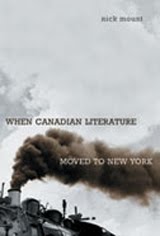
Another passage from Nick Mount's When Canadian Literature Moved to New York that I can't resist sharing:

But however legitimate a concern for cultural nationalists, for the literary historian, national divisions hide more than they reveal. A national focus was essential for recognizing Canadian literature's arrival, and it remains essential for periodically reaffirming its health, but it cannot explain the actual circumstances of much of that literature's production. No national model can account for [Bliss] Carman writing the first of his Vagabondia poems after reading an English law book in a New York library, or for Palmer Cox creating his Brownies by combining the Scottish legends he heard as a child in Quebec with the skills he acquired as a cartoonist in California, or for Ernest Thompson Seton submitting his career-launching story about a New Mexico wolf to a New York magazine because he was urged to do so by a Toronto economist⎯or indeed for the circumstances that produced any literary work, in any literature.

Late 19th century focus notwithstanding, this still resonates today. For a bit more on Mount's book, see my post below.

A Continental Literary Culture


An interesting snippet from one of my current reads, Nick Mount's When Canadian Literature Moved to New York, a book that traces the roots of what ultimately became a canonical Canadian literature to "the cafés, publishing offices, and boarding houses of late-nineteenth-century New York":

The problems confronting domestic literary production were real, but the domestic market was not the only option for Canadian writers of this generation: they also had access by mail or in person to the much larger American market, a market that by this time included Canada. Canadians had few home-grown literary models, but the flood of American magazines and American books into Canada provided models for them, models that had become features of a North American literary landscape. At a professional level, the decision by so many Canadian writers of these years to move to American cities wasn't about giving up one national literary culture for another; it was about moving from the margins to the centres of a continental literary culture.

My primary interest in this literary period is in L.M. Montgomery, one of the few Canadian writers who stayed at home. But the expatriates whose late 19th century exodus to the United States preoccupies Mount were Montgomery's precursors and contemporaries, her role models and her colleagues. Their markets were her markets. She may have stayed home physically, resisting the lure of New York as did her writer-character Emily Byrd Starr, but she built her career on the publication of stories in U.S. magazines and of novels by U.S. publishing houses. So Mount's book provides a context that I think will prove very helpful in developing a fuller understanding of Montgomery's career, even though she herself receives only a few passing mentions in it. As you can imagine from the passage quoted above though, the book also offers much food for thought in considering Canadian literature more broadly, now as then evolving in a global context. So far, a most intriguing read.